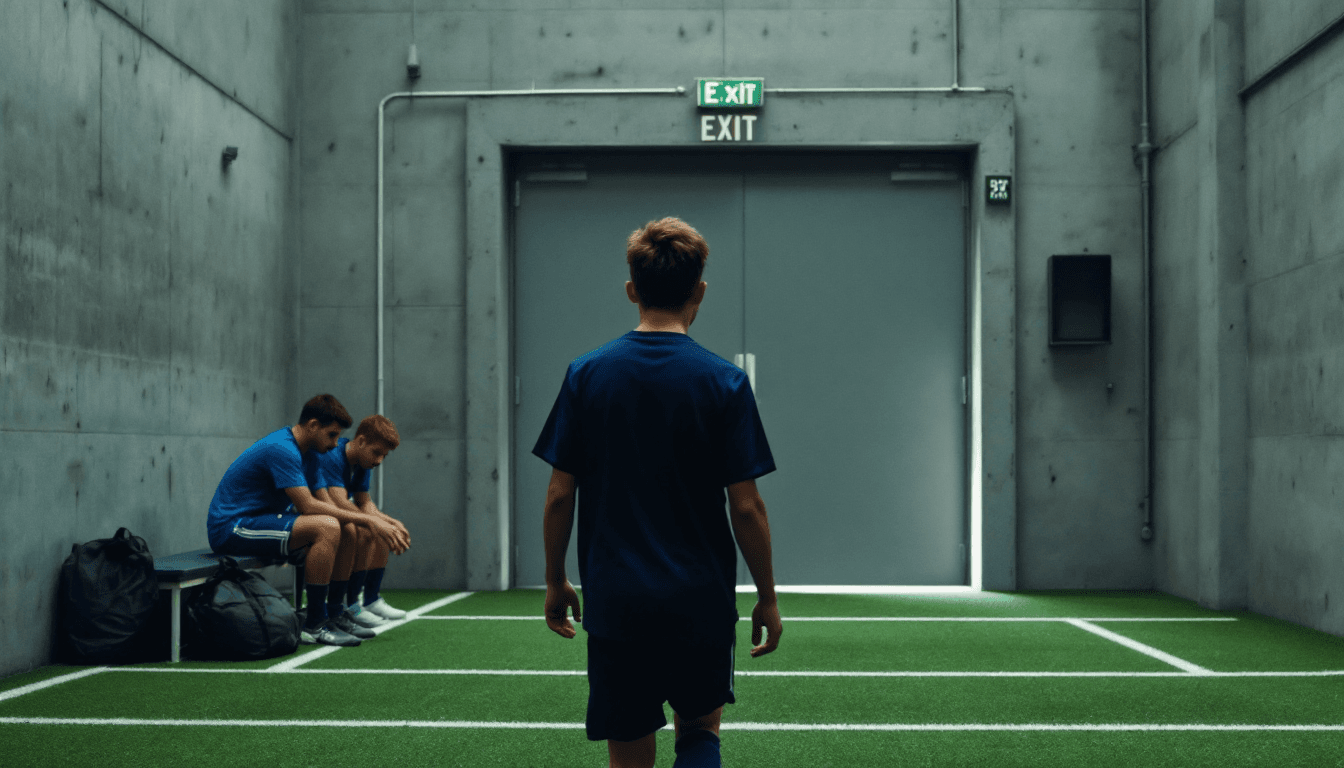
What Scouts Look for in the First 8 Minutes
 Scout Me Pro
A scout arrives at a ground on a Tuesday night. Cold. Maybe raining. They've got a name written on a piece of paper — yours, if you're lucky — and they're going to watch you for roughly eight minutes before they've formed the bones of an opinion.
Eight minutes. That's not a stereotype or a complaint. It's how the job works. A professional scout watching three or four games a week is processing thousands of minutes of football. They can't afford to be patient. Neither can you.
The question worth asking — the one most players never actually answer — is: what are they looking at during those eight minutes? Not in some vague, general sense. Specifically. In order.
It Starts Before You Touch the Ball
The first thing a scout assesses has nothing to do with your feet. It's your shape — where you position yourself before the ball arrives, and what your body tells them about whether you already know what you're going to do with it.
Elite players arrive at the ball in a body shape that gives them options. Their hips are open, their head is up, and they've already scanned the space around them in the three seconds before the pass arrives. Average players arrive and then decide. That half-second difference is one of the clearest signals a scout has that a player operates at a level above their current surroundings.
This is the shoulder check. It sounds simple because it is. But observation from professional environments consistently shows that top midfielders and defenders check their shoulders two to three times more frequently than players who never progress beyond the lower leagues. Scouts know this. They're watching for it before the first whistle's barely stopped ringing.
A scout isn't counting your shoulder checks with a tally sheet — but they notice when a player seems to know where pressure is coming from without having to look twice. It's a feel, and it registers immediately.
First Touch Under Passive and Active Pressure
Once a scout has clocked your movement off the ball, the next thing they're waiting for is what happens when the ball actually reaches you. Specifically, they want to see your first touch — and not just whether it's clean, but where it goes.
A good first touch in open space tells a scout very little. Plenty of players can control a ball when nobody is near them. What separates levels is the touch that comes when an opponent is closing, or when the easy option is back the way the ball came. Does your touch move the ball into a position that progresses play? Does it set up a pass or a turn that puts you in a better situation than you were in a second ago? Or does it simply keep you safe?
Scouts talk about touches that "go somewhere." A centre-back whose first touch angles out of pressure towards the wide channel rather than back to the goalkeeper. A winger who kills the ball on the half-turn rather than trapping it flat-footed. These are not flashy. They are functional, and they tell a scout whether a player is comfortable at the tempo the scout's club actually plays at.
Consider Luka Vušković, the 19-year-old Croatian centre-back who just completed a €54m move to Brighton. He made his senior debut at Hajduk Split two days after turning 16, and last season recorded the Bundesliga's best duel success rate at 69.1%. That kind of defender doesn't get spotted because he's tall — he gets spotted because his first touch under pressure consistently moves the ball forward into positions that bypass the press. Scouts see that in the first few minutes.
Reactions to Losing the Ball
This one catches players off guard, because most young footballers assume scouts are only watching what they do well. In reality, a scout learns more about a player's mentality and potential from what happens in the two or three seconds after a mistake.
When you give the ball away — and you will, several times in any match — do you immediately try to win it back? Do you adjust your position to cover the space you've just left exposed? Or do you drop your head, slow down, and wait for someone else to clean up?
The reaction window is tiny. Two seconds, maybe three. But it reveals something that is very difficult to coach: competitive instinct. A player who transitions instantly from attack to recovery, without any visible frustration or delay, signals to a scout that they can handle the psychological demands of a higher level. A player who dwells on the error, even briefly, raises a question mark.
Communication and Game Awareness
Scouts also notice who talks. Not shouting for the sake of it — that's noise, and experienced scouts filter it out quickly. They're listening for players who organise: who calls a runner, who tells a teammate to switch, who demands the ball in a pocket of space and actually means it.
Communication is tied directly to awareness. A player who talks is usually a player who sees the game. A player who sees the game can be moved up a level without falling apart, because they are processing information rather than simply reacting to it.
What This Means for You
None of this is about performing tricks or trying to catch the eye with a spectacular moment. Scouts are often suspicious of players who seem to be playing for highlights. The eight-minute window rewards consistency, intelligence and effort — the things that are hardest to fake and easiest to overlook when you're focused on impressing people.
The things scouts value most are largely within your control. You can practise scanning. You can work on the direction of your first touch. You can train yourself to react immediately when possession changes. You can start talking on the pitch, even if it feels unnatural at first. These are habits, not talents, and habits can be built on any training ground in any league in any country.
If you want to give yourself the best chance during those eight minutes, the honest answer is unglamorous: be the player who looks like they understand what's happening around them, and who works regardless of whether things are going well.
Scout Me Pro is live and free on the App Store and Google Play — a place to upload your match footage and build a profile that's there when it needs to be. scoutmepro.com/#download.
Sources
- Brighton & Hove Albion official site / Transfermarkt — 14 Jul 2026